


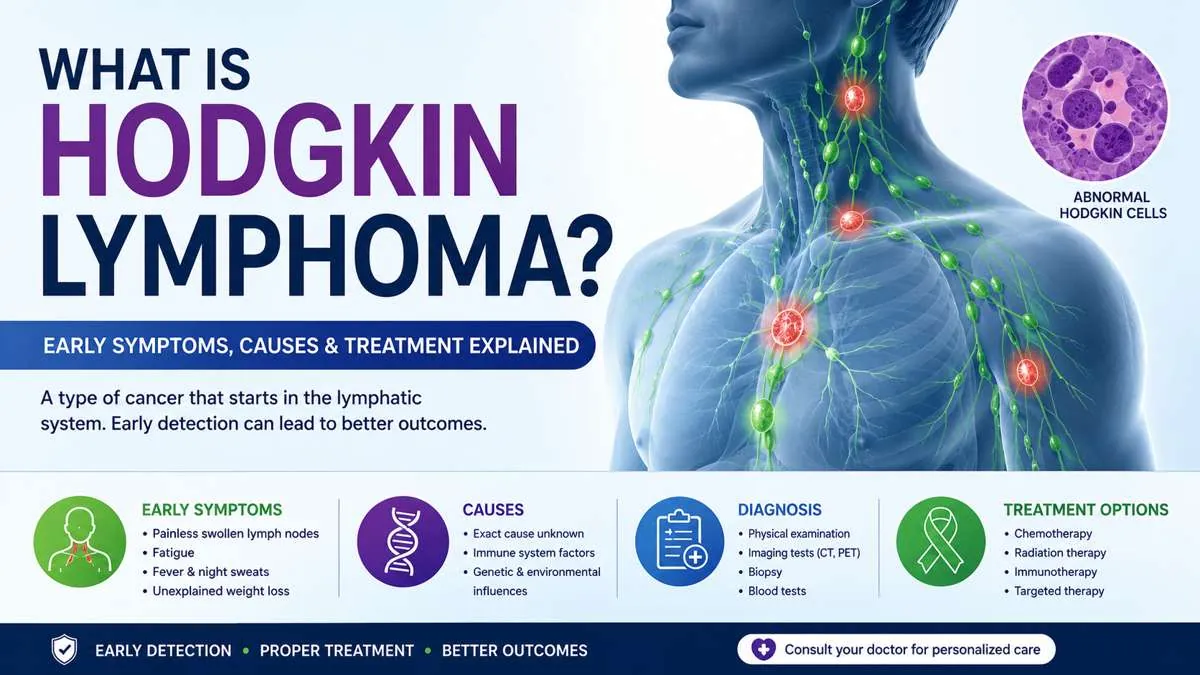
Hodgkin lymphoma (formerly called Hodgkin’s disease) is a type of cancer that develops in the lymphatic system, an important part of your immune system. It begins when certain white blood cells called lymphocytes grow abnormally and multiply uncontrollably.
Unlike many other cancers, Hodgkin lymphoma is considered one of the most treatable and curable cancers, especially when diagnosed in its early stages. Modern treatments have significantly improved survival rates, allowing many people to live long, healthy lives after treatment.
In this guide, you’ll learn what Hodgkin lymphoma is, its symptoms, causes, diagnosis, treatment options, and outlook.
Medical Disclaimer: This article is for educational purposes only and should not replace professional medical advice, diagnosis, or treatment. Always consult a qualified healthcare provider regarding any health concerns.
What Is the Lymphatic System?
The lymphatic system is a network of vessels, lymph nodes, and organs that helps your body:
- Fight infections
- Remove waste and excess fluid
- Support immune function
Major parts of the lymphatic system include:
- Lymph nodes
- Spleen
- Bone marrow
- Thymus
- Tonsils
- Lymphatic vessels
Because lymph tissue exists throughout the body, Hodgkin lymphoma can develop in multiple locations.
What Is Hodgkin Lymphoma?
Hodgkin lymphoma is a cancer that usually starts in the lymph nodes, most commonly in the:
- Neck
- Chest
- Underarms
A defining feature of Hodgkin lymphoma is the presence of Reed-Sternberg cells, which are large abnormal B lymphocytes visible under a microscope. Their presence helps distinguish Hodgkin lymphoma from non-Hodgkin lymphoma.
The disease often spreads from one group of lymph nodes to nearby lymph nodes in a predictable pattern.
Types of Hodgkin Lymphoma
There are two main types.
1. Classical Hodgkin Lymphoma (CHL)
This accounts for approximately 90–95% of cases.
Subtypes include:
- Nodular sclerosis
- Mixed cellularity
- Lymphocyte-rich
- Lymphocyte-depleted
2. Nodular Lymphocyte-Predominant Hodgkin Lymphoma (NLPHL)
This is much less common.
Characteristics include:
- Slow-growing
- Different cancer cells than classical Hodgkin lymphoma
- Often treated differently
- Generally has an excellent prognosis
Symptoms of Hodgkin Lymphoma
Many people first notice a painless swollen lymph node.
Common symptoms include:
Swollen Lymph Nodes
Usually found in:
- Neck
- Armpit
- Groin
- Above the collarbone
These swollen nodes are typically painless.
Persistent Fatigue
Feeling unusually tired that doesn’t improve with rest.
Fever
Recurring or unexplained fever without an obvious infection.
Night Sweats
Heavy sweating during sleep that may soak clothing or bedding.
Unexplained Weight Loss
Losing more than 10% of body weight over six months without trying.
Itchy Skin
Some individuals experience severe itching without a visible rash.
Chest Symptoms
If lymph nodes in the chest enlarge, they may cause:
- Persistent cough
- Chest discomfort
- Shortness of breath
Loss of Appetite
Reduced appetite may accompany advanced disease.
What Are “B Symptoms”?
Doctors pay special attention to three symptoms called B symptoms, which can indicate more active disease:
- Fever above 100.4°F (38°C)
- Drenching night sweats
- Unexplained weight loss
These symptoms help determine the stage and treatment approach.
Causes of Hodgkin Lymphoma
The exact cause remains unknown.
Researchers believe Hodgkin lymphoma develops after genetic changes occur in lymphocytes, causing them to multiply uncontrollably.
Risk Factors
Several factors may increase risk.
Age
Hodgkin lymphoma is most common in:
- Young adults (15–35 years)
- Adults over 55 years
Epstein-Barr Virus (EBV)
Previous infection with EBV (which causes mononucleosis) may increase the risk.
Family History
Having a close relative with Hodgkin lymphoma slightly raises risk.
Weakened Immune System
Risk is higher in people with:
- HIV infection
- Organ transplants
- Certain immune disorders
Male Sex
Some forms occur slightly more often in men.
How Is Hodgkin Lymphoma Diagnosed?
Diagnosis usually involves several tests.
Physical Examination
Your healthcare provider checks for:
- Enlarged lymph nodes
- Enlarged spleen
- Enlarged liver
Blood Tests
Blood work may evaluate:
- Blood cell counts
- Liver function
- Kidney function
- Signs of infection or inflammation
Lymph Node Biopsy
This is the most important test.
Doctors remove all or part of an enlarged lymph node to examine it under a microscope.
Finding Reed-Sternberg cells confirms classical Hodgkin lymphoma.
Imaging Tests
Imaging helps determine how far the cancer has spread.
Common tests include:
- CT scan
- PET scan
- MRI (occasionally)
Bone Marrow Biopsy
This test may be needed if doctors suspect the lymphoma has spread to the bone marrow.
Stages of Hodgkin Lymphoma
Doctors classify Hodgkin lymphoma into four stages.
Stage I
Cancer affects one lymph node region.
Stage II
Cancer affects two or more lymph node regions on the same side of the diaphragm.
Stage III
Cancer is found on both sides of the diaphragm.
Stage IV
Cancer has spread to organs such as:
- Liver
- Bone marrow
- Lungs
Treatment Options
Treatment depends on:
- Stage
- Type
- Age
- Overall health
- Symptoms
Common treatments include:
Chemotherapy
Chemotherapy is the main treatment for most patients.
It uses medicines to destroy cancer cells throughout the body.
Radiation Therapy
High-energy radiation targets lymphoma cells in specific areas.
Radiation may be used after chemotherapy for early-stage disease.
Targeted Therapy
Some patients receive medicines that attack specific cancer cell proteins while minimizing damage to healthy cells.
Immunotherapy
Checkpoint inhibitors help the immune system recognize and destroy cancer cells.
They are often used for relapsed or treatment-resistant Hodgkin lymphoma.
Stem Cell Transplant
Patients whose lymphoma returns after treatment may benefit from:
- Autologous stem cell transplant
- Allogeneic stem cell transplant (selected cases)
Possible Side Effects of Treatment
Treatment side effects vary but may include:
- Fatigue
- Hair loss
- Nausea
- Low blood cell counts
- Increased infection risk
- Fertility concerns
- Long-term heart or lung complications (depending on treatment)
Doctors carefully monitor patients to reduce these risks.
Survival Rate and Prognosis
Hodgkin lymphoma has one of the highest cure rates among cancers.
Factors affecting prognosis include:
- Stage at diagnosis
- Age
- Overall health
- Response to treatment
Many people diagnosed with early-stage Hodgkin lymphoma achieve long-term remission or are cured. Even advanced-stage disease can often be treated successfully with modern therapies.
Can Hodgkin Lymphoma Be Prevented?
There is currently no proven way to prevent Hodgkin lymphoma.
However, maintaining overall health may support your immune system by:
- Eating a balanced diet
- Exercising regularly
- Avoiding tobacco
- Limiting alcohol
- Managing chronic illnesses
- Attending routine medical checkups
When Should You See a Doctor?
Seek medical evaluation if you experience:
- Swollen lymph nodes lasting longer than two weeks
- Persistent fever
- Night sweats
- Unexplained weight loss
- Constant fatigue
- Ongoing cough or chest discomfort
- Unexplained itching
Early diagnosis improves treatment success.
Frequently Asked Questions (FAQs)
Is Hodgkin lymphoma curable?
Yes. Hodgkin lymphoma is considered one of the most curable cancers, especially when diagnosed early and treated appropriately.
Is Hodgkin lymphoma the same as non-Hodgkin lymphoma?
No. They are different diseases. Hodgkin lymphoma is identified by the presence of Reed-Sternberg cells, while non-Hodgkin lymphoma includes many different lymphoma subtypes without these cells.
Is Hodgkin lymphoma hereditary?
Most cases are not inherited. Although a family history may slightly increase the risk, the majority of people diagnosed have no close relatives with the disease.
Does Hodgkin lymphoma spread quickly?
It often spreads in a predictable pattern from one lymph node group to nearby nodes. The speed of progression varies depending on the subtype and individual factors.
Can Hodgkin lymphoma come back after treatment?
Yes. While many people are cured, some experience a recurrence. Fortunately, effective treatment options are available for relapsed disease.
Key Takeaways
- Hodgkin lymphoma is a cancer of the lymphatic system that starts in lymphocytes.
- A painless swollen lymph node is often the first noticeable symptom.
- Reed-Sternberg cells are the hallmark of classical Hodgkin lymphoma.
- Common symptoms include fever, night sweats, fatigue, itching, and unexplained weight loss.
- Diagnosis relies on a lymph node biopsy, imaging tests, and blood work.
- Treatment may include chemotherapy, radiation therapy, targeted therapy, immunotherapy, or stem cell transplantation.
- Hodgkin lymphoma is highly treatable, and many patients achieve long-term remission or cure with modern therapies.