


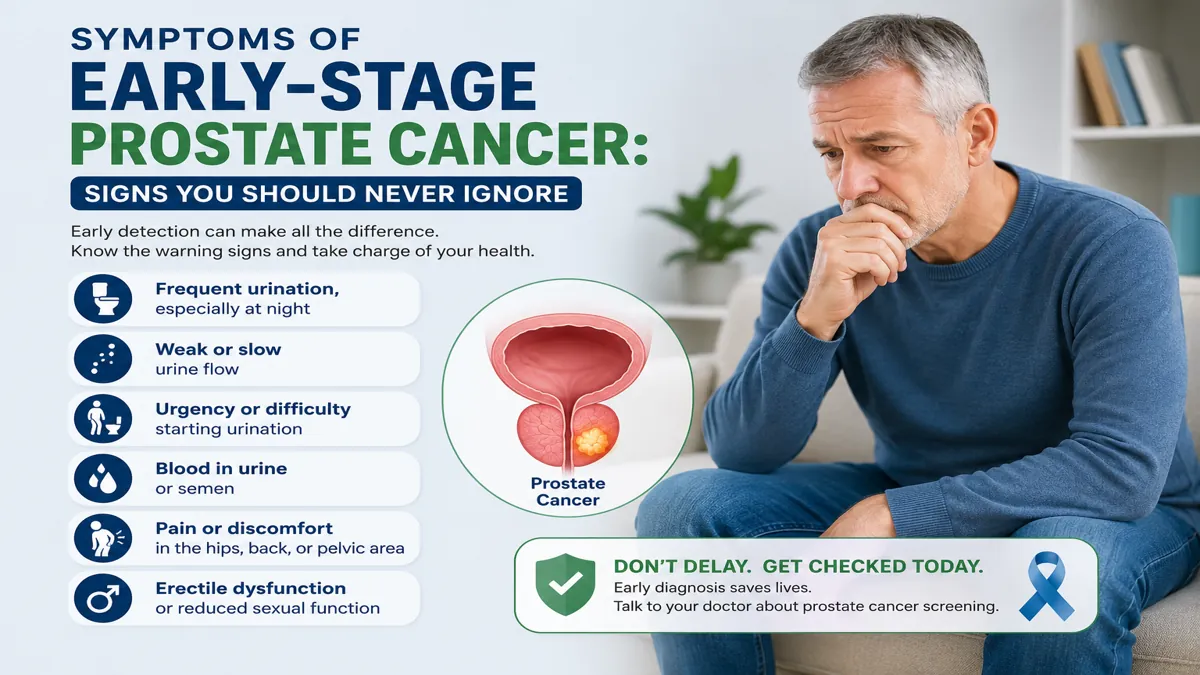
Prostate cancer is one of the most common cancers affecting men worldwide. The good news is that when detected early, it is often highly treatable and has an excellent survival rate. However, one of the biggest challenges is that early-stage prostate cancer usually causes no noticeable symptoms.
Many men assume that prostate cancer always leads to urinary problems, but this isn’t always true. In fact, most early-stage prostate cancers are discovered during routine screening tests rather than because of symptoms.
In this article, we’ll explain the symptoms of early-stage prostate cancer, why they may occur, who is at risk, when to seek medical advice, and how doctors diagnose and treat the disease.
What Is Early-Stage Prostate Cancer?
The prostate is a small, walnut-sized gland located below the bladder and in front of the rectum. It produces fluid that nourishes and transports sperm.
Early-stage prostate cancer refers to cancer that is confined to the prostate gland and has not spread to nearby tissues, lymph nodes, or distant organs. At this stage, treatment is often most effective.
Does Early-Stage Prostate Cancer Cause Symptoms?
In many cases, no.
Most men with early-stage prostate cancer feel perfectly healthy. The cancer grows slowly, and small tumors usually don’t interfere with the normal function of the prostate.
This is why regular screening may be recommended for men at higher risk.
Symptoms of Early-Stage Prostate Cancer
Although symptoms are uncommon, some men may experience subtle warning signs.
1. Frequent Urination
One of the earliest symptoms can be needing to urinate more often than usual, especially during the night (nocturia).
You may notice:
- Waking several times at night to urinate
- Increased daytime urination
- Feeling the urge to urinate more frequently
However, this symptom is much more commonly caused by benign prostatic hyperplasia (BPH) than prostate cancer.
2. Difficulty Starting Urination
Some men find it difficult to begin urinating even when they feel the urge.
Signs include:
- Hesitation before urine starts flowing
- Weak initiation of urine stream
- Straining to urinate
This happens when the enlarged prostate presses against the urethra.
3. Weak or Interrupted Urine Stream
A weaker-than-normal urine flow may develop.
Symptoms include:
- Reduced urine pressure
- Stopping and starting while urinating
- Difficulty completely emptying the bladder
Again, this symptom is more commonly linked to non-cancerous prostate enlargement.
4. Feeling That the Bladder Doesn’t Empty Completely
After urinating, you may still feel like your bladder is full.
This can lead to:
- Returning to the bathroom shortly after urinating
- Persistent sensation of incomplete emptying
- Mild discomfort
5. Pain or Burning During Urination
Although less common in early prostate cancer, some men report:
- Burning sensation while urinating
- Mild discomfort
- Irritation
More often, these symptoms are caused by urinary tract infections or prostatitis.
6. Blood in the Urine
Blood in the urine (hematuria) is uncommon but should never be ignored.
The urine may appear:
- Pink
- Red
- Brownish
Even a small amount of blood warrants medical evaluation.
7. Blood in Semen
Some men notice blood during ejaculation.
Although blood in semen often has harmless causes, persistent episodes should be evaluated by a healthcare provider.
8. Erectile Dysfunction
Difficulty achieving or maintaining an erection can occasionally occur.
While erectile dysfunction is usually caused by aging, diabetes, cardiovascular disease, or medications, prostate cancer may contribute in some cases.
9. Mild Pelvic Discomfort
Some men experience vague discomfort in:
- Lower pelvis
- Perineum (area between the scrotum and anus)
- Lower back
Persistent pain should be discussed with a healthcare professional.
Symptoms That Usually Indicate More Advanced Prostate Cancer
When prostate cancer spreads beyond the prostate, symptoms become more noticeable.
These may include:
- Persistent bone pain
- Severe lower back pain
- Hip pain
- Weight loss
- Fatigue
- Leg swelling
- Difficulty walking
- Loss of bladder or bowel control (rare but serious)
These symptoms require prompt medical evaluation.
Why Early Prostate Cancer Often Has No Symptoms
Small prostate tumors generally don’t block urine flow or invade nearby structures.
Instead, they remain confined to a tiny area of the prostate for years.
Because of this:
- No pain develops
- Urination remains normal
- Sexual function may be unaffected
- Daily life continues as usual
This is why screening can play an important role in early detection for some men.
Risk Factors for Prostate Cancer
Several factors increase the risk of developing prostate cancer.
Age
Risk rises significantly after age 50.
Family History
Having a father or brother with prostate cancer increases your risk.
Genetics
Inherited mutations such as BRCA1 and BRCA2 can increase prostate cancer risk.
Race
Men of African ancestry have a higher risk of developing aggressive prostate cancer.
Obesity
Obesity has been linked to a higher risk of advanced prostate cancer.
Diet
A diet high in processed meats and saturated fats and low in fruits and vegetables may contribute to overall cancer risk.
When Should You See a Doctor?
Consult a healthcare provider if you experience:
- Blood in urine
- Blood in semen
- Difficulty urinating
- Frequent nighttime urination
- Persistent urinary symptoms
- Pelvic discomfort
- Family history of prostate cancer
- Unexplained weight loss
Even if symptoms are caused by another condition, proper evaluation is important.
How Is Early Prostate Cancer Diagnosed?
Doctors use several methods to detect prostate cancer.
PSA Blood Test
The prostate-specific antigen (PSA) test measures a protein produced by the prostate. Elevated PSA levels can be associated with prostate cancer but may also result from benign enlargement or inflammation.
Digital Rectal Examination (DRE)
During a DRE, a healthcare provider inserts a gloved, lubricated finger into the rectum to check the prostate for abnormalities such as hard areas or irregularities.
MRI Scan
Multiparametric MRI can help identify suspicious areas and guide the need for a biopsy.
Prostate Biopsy
If cancer is suspected, a biopsy removes small tissue samples from the prostate for microscopic examination. A biopsy is the only way to confirm a prostate cancer diagnosis.
Treatment Options for Early-Stage Prostate Cancer
Treatment depends on factors such as the cancer’s stage, grade, PSA level, age, overall health, and patient preferences.
Options may include:
Active Surveillance
Suitable for many men with low-risk prostate cancer. Regular PSA tests, imaging, and repeat biopsies monitor the cancer without immediate treatment.
Surgery
Radical prostatectomy removes the prostate gland and may be recommended for localized cancer.
Radiation Therapy
External beam radiation or brachytherapy can effectively treat many early-stage cancers.
Hormone Therapy
Usually reserved for certain higher-risk or advanced cases and may be combined with radiation therapy.
Your healthcare team will discuss the most appropriate treatment plan based on your individual situation.
Can Early Prostate Cancer Be Prevented?
There is no guaranteed way to prevent prostate cancer, but healthy lifestyle habits may support overall prostate health.
Consider:
- Eating plenty of fruits and vegetables
- Choosing whole grains and lean proteins
- Limiting processed and red meats
- Exercising regularly
- Maintaining a healthy weight
- Avoiding tobacco use
- Limiting alcohol intake
- Discussing screening with your healthcare provider if you are at increased risk
Frequently Asked Questions (FAQs)
What are the first symptoms of prostate cancer?
Many men have no symptoms in the early stages. When symptoms occur, they may include frequent urination, a weak urine stream, difficulty starting urination, blood in the urine or semen, or a feeling of incomplete bladder emptying.
Can prostate cancer exist without symptoms?
Yes. Most early-stage prostate cancers are asymptomatic and are detected through PSA testing or a digital rectal examination.
Is frequent urination always a sign of prostate cancer?
No. Frequent urination is more commonly caused by benign prostatic hyperplasia (BPH), urinary tract infections, or an overactive bladder than by prostate cancer.
At what age should men be screened?
Screening recommendations vary. Many medical organizations suggest discussing the benefits and risks of PSA screening with a healthcare provider starting around age 50 for average-risk men and earlier—often ages 40–45—for those at higher risk, such as men with a strong family history or certain inherited genetic mutations.
Is early-stage prostate cancer curable?
Many cases of localized prostate cancer can be successfully treated, and long-term outcomes are generally excellent when the disease is detected early.
Key Takeaways
Early-stage prostate cancer often develops silently, making routine medical evaluation and informed discussions about screening important—especially for men at higher risk. While urinary symptoms such as frequent urination, a weak urine stream, or difficulty starting urination can occur, they are more commonly caused by non-cancerous prostate conditions. Any persistent urinary changes, blood in the urine or semen, or other concerning symptoms should be assessed by a healthcare provider. Early diagnosis offers the best opportunity for effective treatment and favorable long-term outcomes.