


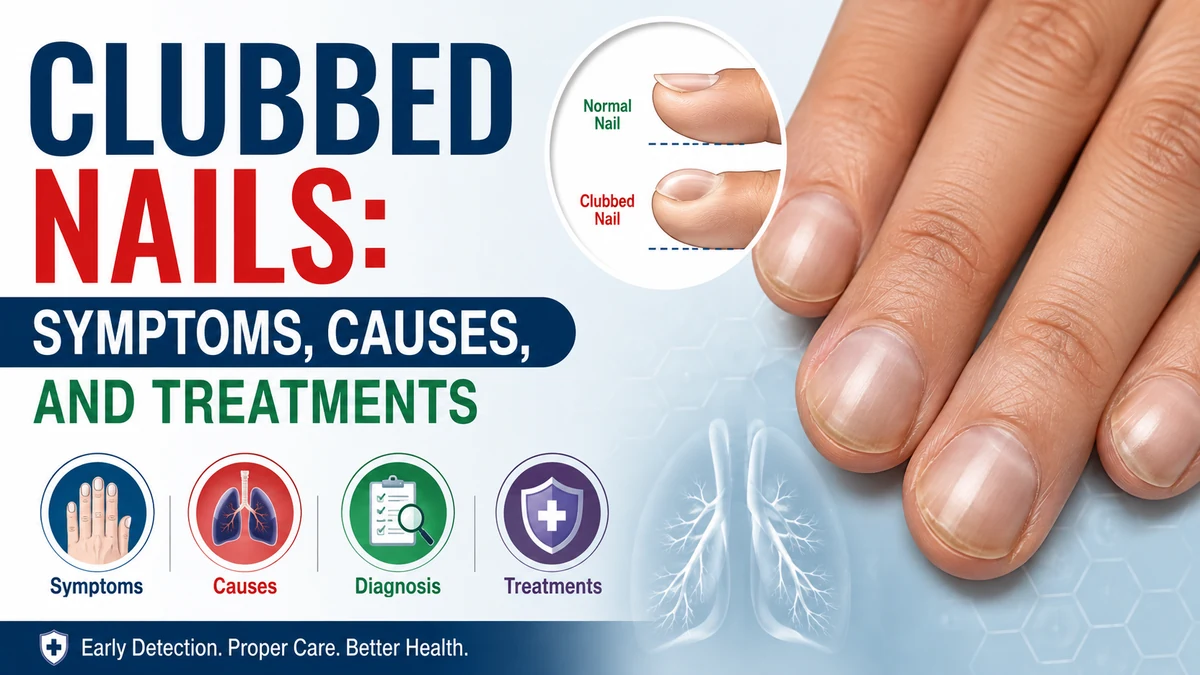
Clubbed nails are a noticeable change in the shape and appearance of the fingernails or toenails. In this condition, the nails become more curved and rounded, while the fingertips may appear wider or swollen. Clubbing usually develops gradually and can affect one or more nails.
Although clubbed nails are not usually painful, they can sometimes be an important sign of an underlying medical condition. In particular, nail clubbing may be associated with certain lung, heart, digestive, or other systemic diseases.
Understanding the symptoms, causes, diagnosis, and treatment of clubbed nails can help identify when medical evaluation is needed.
What Are Clubbed Nails?
Clubbed nails, also known as digital clubbing or nail clubbing, occur when the tissue beneath the nail changes, causing the nail to become more rounded and curved. The fingertips may also become broader or appear bulbous.
In healthy nails, the nail plate generally has a relatively flat or gently curved appearance. With clubbing, the nail becomes increasingly convex, and the angle between the nail and surrounding skin changes.
Clubbed nails are usually not a disease by themselves. Instead, they may be a physical sign of another health condition.
Symptoms of Clubbed Nails
Nail clubbing often develops slowly, so the changes may not be obvious at first. Common signs and symptoms include:
- Nails becoming more curved or rounded
- Increased curvature from side to side
- Fingertips becoming wider or swollen
- A soft or spongy feeling around the nail bed
- Nails appearing shiny or more convex than usual
- Changes in the angle where the nail meets the skin
- Enlargement of the ends of the fingers or toes
- Nails that seem to wrap around the fingertips
In advanced cases, the fingertips may develop a characteristic bulbous or drumstick-like appearance.
Does Clubbing Affect All Nails?
It can affect several fingers or toes on both hands and feet. However, the pattern can vary depending on the underlying cause.
If only one nail or a small number of nails change shape, it may have a local cause, such as trauma or another nail disorder, rather than true digital clubbing.
What Causes Clubbed Nails?
There are several possible causes of clubbed nails. In many cases, clubbing is associated with a condition that affects the lungs, heart, or other organs.
1. Lung Diseases
Lung conditions are among the most important causes associated with digital clubbing.
Possible causes include:
- Lung cancer
- Bronchiectasis
- Cystic fibrosis
- Certain chronic lung infections
- Interstitial lung diseases
- Some other long-term pulmonary disorders
Because clubbing can occasionally occur with serious lung disease, unexplained changes in the nails should not be ignored.
2. Heart Conditions
Certain cardiovascular conditions can also be associated with clubbing.
These may include some congenital heart diseases and conditions that cause long-term low oxygen levels in the blood.
However, not everyone with heart disease develops clubbed nails.
3. Digestive and Liver Disorders
Some gastrointestinal and liver conditions have also been linked with digital clubbing.
Examples include:
- Inflammatory bowel disease, including Crohn’s disease and ulcerative colitis
- Certain chronic liver diseases
- Some malabsorption disorders
The exact relationship between these diseases and nail clubbing is not completely understood.
4. Infections
Some long-lasting infections may cause clubbing, particularly infections involving the lungs or heart.
Examples can include certain chronic pulmonary infections and infections affecting the heart valves.
5. Genetic or Familial Clubbing
In some people, clubbed nails can run in families. Familial clubbing may occur without an underlying serious illness.
In these cases, nail changes may be present for many years and may affect other family members as well.
6. Other Medical Conditions
Less commonly, digital clubbing may occur alongside other disorders, including certain cancers and systemic diseases.
Because the possible causes are diverse, doctors generally consider a person’s other symptoms, medical history, and examination findings before deciding whether further testing is necessary.
What Does Nail Clubbing Look Like?
The appearance of clubbing can vary from person to person. Typical changes include:
Normal nails:
- Relatively flat nail surface
- Normal fingertip shape
- Normal nail-to-skin angle
Clubbed nails:
- Increased nail curvature
- Rounded or convex nail surface
- Enlarged fingertips
- Swollen or spongy nail beds
- Bulbous appearance of the fingertips
One commonly used clinical assessment is the Schamroth window test. When the same fingers from opposite hands are placed together nail-to-nail, a small diamond-shaped space is normally visible between the nails. This space may disappear in people with significant clubbing.
However, this test is not a substitute for a medical examination.
Is Nail Clubbing Serious?
Clubbed nails can sometimes be a sign of a serious underlying disease, but they are not always dangerous themselves.
For some people, clubbing is inherited and does not indicate a major health problem. In other cases, it can be associated with lung cancer, chronic lung disease, heart disease, or inflammatory disorders.
If clubbing develops recently and there is no obvious explanation, it is important to consult a healthcare professional.
How Are Clubbed Nails Diagnosed?
Doctors usually diagnose nail clubbing through a physical examination.
During the evaluation, a healthcare professional may:
- Examine the nails and fingertips.
- Ask when the nail changes began.
- Review your medical and family history.
- Look for other physical symptoms.
- Check oxygen levels when appropriate.
- Order additional tests if an underlying condition is suspected.
The tests depend on the person’s symptoms and medical history.
Possible investigations may include:
- Blood tests
- Chest X-ray
- CT scan of the chest
- Pulmonary function tests
- Heart tests such as an echocardiogram
- Other imaging or laboratory tests
Not everyone with clubbing needs every test.
Treatment for Clubbed Nails
There is no single treatment specifically designed to reverse clubbing in every person. Treatment generally focuses on identifying and managing the underlying cause.
For example:
- An underlying lung condition may require respiratory treatment.
- A heart condition may require medication, monitoring, or other cardiac treatment.
- Inflammatory bowel disease may require treatment to control intestinal inflammation.
- An infection may require appropriate antimicrobial treatment.
When the underlying condition is successfully treated, clubbing may sometimes improve. However, nail changes may not completely disappear, particularly if clubbing has been present for a long time.
Can You Treat Clubbed Nails at Home?
There is no proven home remedy that can reliably reverse true digital clubbing.
Keeping nails clean and properly trimmed can improve their appearance and reduce the risk of nail injuries, but these measures do not treat the underlying cause.
Avoid using unproven supplements, oils, or nail products that claim to cure clubbing.
When Should You See a Doctor?
You should consider seeing a healthcare professional if you notice new or unexplained changes in the shape of your nails or fingertips.
Medical evaluation is especially important if nail changes occur along with:
- Persistent cough
- Shortness of breath
- Chest discomfort
- Unexplained weight loss
- Persistent fatigue
- Recurrent respiratory infections
- Fever or night sweats
- Digestive symptoms
- Swelling or other unexplained symptoms
Seek urgent medical care for severe breathing difficulty, significant chest pain, bluish lips or skin, or other symptoms suggesting a medical emergency.
Can Clubbed Nails Be Prevented?
Because clubbing can have many different causes, there is no guaranteed way to prevent it.
However, maintaining overall health and managing chronic medical conditions can reduce the risk of complications associated with some underlying causes.
Helpful measures include:
- Avoiding tobacco smoke
- Managing existing chronic diseases
- Getting persistent respiratory symptoms evaluated
- Following prescribed treatments
- Maintaining a balanced diet
- Keeping up with routine medical checkups
Clubbed Nails vs. Other Nail Changes
Not every curved, discolored, or thickened nail represents clubbing.
Several common nail problems can cause changes in appearance, including:
- Fungal nail infections
- Nail trauma
- Psoriasis
- Ingrown nails
- Nutritional deficiencies
- Normal age-related nail changes
This is why self-diagnosis can be difficult. A healthcare professional can determine whether the changes represent true clubbing or another nail condition.
Frequently Asked Questions About Clubbed Nails
Can clubbed nails grow back normally?
It depends on the underlying cause. If clubbing is related to a treatable medical condition, the nails may gradually improve after the condition is controlled. In some cases, however, the changes can persist.
Are clubbed nails always a sign of cancer?
No. Clubbed nails do not always mean cancer. They can occur because of several lung, heart, digestive, infectious, genetic, and other conditions. Some people have familial clubbing without an underlying serious disease.
Are clubbed nails painful?
Digital clubbing itself is generally not painful. However, the medical condition causing the clubbing may produce pain or other symptoms.
Can vitamin deficiency cause clubbed nails?
Some nutritional deficiencies can cause changes in the nails, but true digital clubbing is more commonly associated with underlying lung, heart, digestive, infectious, or systemic conditions. A healthcare professional can help determine the cause of unusual nail changes.
How long does it take for clubbing to develop?
Clubbing generally develops gradually, although the speed can vary depending on the underlying condition.
Final Thoughts
Clubbed nails are a physical change in the nails and fingertips that can have several possible causes. While some cases are inherited and harmless, newly developed clubbing can sometimes indicate an underlying lung, heart, digestive, infectious, or systemic condition.
There is no universal treatment for clubbed nails. The most important step is to determine whether an underlying medical condition is responsible. If you notice persistent or unexplained changes in your nails, particularly when accompanied by other symptoms, consult a healthcare professional for an appropriate evaluation.