
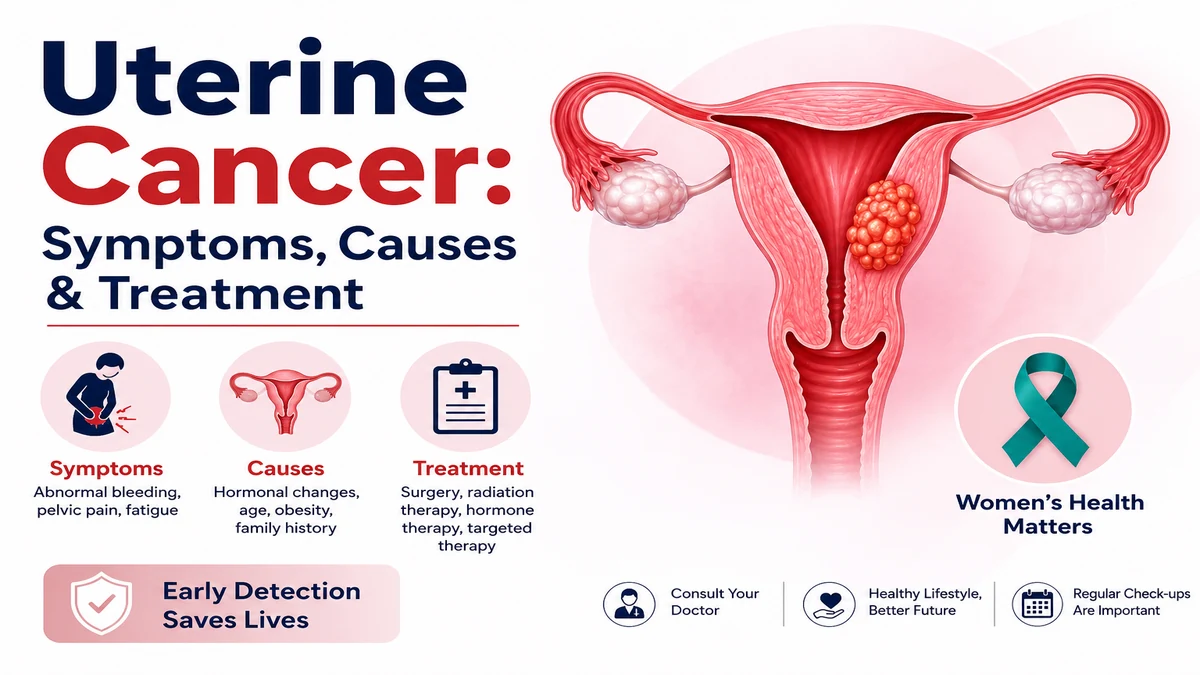
Uterine cancer, often called endometrial cancer, is a cancer that develops in the lining of the uterus (endometrium). It is one of the most common cancers affecting the female reproductive system. In many cases, uterine cancer is detected early because abnormal vaginal bleeding can occur before the disease has spread.
Knowing the symptoms, causes, risk factors, and treatment options for uterine cancer can help people recognize warning signs and seek medical evaluation promptly.
What Is Uterine Cancer?
Uterine cancer occurs when abnormal cells in the uterus begin growing uncontrollably and form a tumor.
The uterus has several layers, but most uterine cancers begin in the endometrium, the inner lining of the uterus. For this reason, the terms uterine cancer and endometrial cancer are sometimes used interchangeably, although they are not technically identical.
There are different types of uterine cancer. Endometrial carcinoma is the most common type, while uterine sarcomas are less common and begin in the muscle or connective tissues of the uterus.
Uterine Cancer Symptoms
One of the most important features of endometrial cancer is that it may cause noticeable symptoms, particularly abnormal vaginal bleeding.
Common uterine cancer symptoms include:
1. Abnormal Vaginal Bleeding
Unusual bleeding is the most common warning sign. It may include:
- Vaginal bleeding after menopause
- Bleeding between menstrual periods
- Periods that are heavier or longer than usual
- Bleeding that occurs more frequently than normal
- Unusual spotting
Any vaginal bleeding after menopause should be evaluated by a healthcare professional.
2. Pelvic Pain
Some people may experience persistent pain, pressure, or discomfort in the lower abdomen or pelvis.
3. Pain During Sex
Pain or discomfort during sexual intercourse can sometimes occur with uterine or other gynecological conditions.
4. Unusual Vaginal Discharge
A watery, pink, bloody, or unusual vaginal discharge may occur.
5. Changes in Menstrual Periods
Before menopause, changes in the regularity, duration, or amount of menstrual bleeding may warrant medical evaluation, especially when they are persistent or unexplained.
6. Difficulty Urinating or Bowel Changes
When uterine cancer becomes more advanced, a tumor may put pressure on nearby organs, potentially causing urinary or bowel-related symptoms.
7. Unexplained Weight Loss
Unintentional weight loss, reduced appetite, weakness, or fatigue may occur in advanced disease but are not specific to uterine cancer.
Important: These symptoms can have many causes other than cancer. However, persistent or unusual vaginal bleeding should not be ignored.
What Causes Endometrial Cancer?
The exact cause of endometrial cancer is not always known. It develops when cells in the uterine lining acquire genetic changes that cause them to multiply abnormally and survive when they should normally die.
Over time, these abnormal cells can form a tumor and potentially spread to nearby tissues or other parts of the body.
The Role of Estrogen
Hormonal factors can play an important role in some endometrial cancers.
Estrogen stimulates growth of the endometrium. When estrogen acts on the uterine lining without enough progesterone to balance its effects, the lining may become excessively thick. Long-term exposure to this hormonal environment can increase the risk of endometrial cancer.
However, uterine cancer can develop for several different reasons, and not everyone with hormonal risk factors develops the disease.
Risk Factors for Uterine Cancer
Several factors may increase the likelihood of developing endometrial cancer.
Obesity
Having excess body fat can increase estrogen levels because fat tissue can convert certain hormones into estrogen. This may increase the risk of endometrial cancer.
Increasing Age
The risk of endometrial cancer generally increases with age, particularly after menopause.
Hormonal Imbalance
Conditions associated with prolonged exposure to estrogen without adequate progesterone may increase risk.
Early Menstruation or Late Menopause
Starting menstruation at a young age or entering menopause later can increase the number of years the endometrium is exposed to estrogen.
Never Having Been Pregnant
People who have never been pregnant may have a higher risk, partly because of differences in lifetime hormonal exposure.
Polycystic Ovary Syndrome (PCOS)
PCOS can cause irregular ovulation and hormonal changes that may increase the risk of endometrial abnormalities.
Endometrial Hyperplasia
Endometrial hyperplasia occurs when the uterine lining becomes unusually thick. Some forms, particularly those with atypical cells, can increase the risk of developing endometrial cancer.
Tamoxifen
Tamoxifen, a medication used to treat or prevent certain types of breast cancer, can increase the risk of endometrial cancer in some people. The benefits of tamoxifen may still outweigh this risk for many patients.
Family History
A family history of uterine, colorectal, or certain other cancers may increase risk.
Lynch Syndrome
Lynch syndrome is an inherited condition that increases the risk of several cancers, including colorectal and endometrial cancer.
Types of Uterine Cancer
Uterine cancers can be divided into several categories.
Endometrial Carcinoma
This is the most common type and begins in the cells lining the uterus.
Endometrial cancers are sometimes further classified based on their microscopic appearance and molecular characteristics. These classifications help doctors estimate prognosis and select appropriate treatment.
Uterine Sarcoma
Uterine sarcomas are uncommon cancers that develop in the muscle or connective tissues of the uterus. Examples include leiomyosarcoma and endometrial stromal sarcoma.
Because different uterine cancers behave differently, treatment depends heavily on the specific type and stage.
How Is Uterine Cancer Diagnosed?
If a healthcare professional suspects endometrial cancer, several tests may be used.
Pelvic Examination
A pelvic examination may help identify abnormalities involving the uterus, cervix, vagina, or surrounding tissues.
Transvaginal Ultrasound
A transvaginal ultrasound uses sound waves to create images of the uterus and can help evaluate the thickness and appearance of the endometrium.
Endometrial Biopsy
An endometrial biopsy involves removing a small sample of tissue from the uterine lining. A laboratory examines the sample under a microscope to determine whether cancer cells are present.
A biopsy is often an important step in confirming endometrial cancer.
Hysteroscopy
During hysteroscopy, a thin camera is inserted through the vagina and cervix into the uterus. This allows a clinician to examine the uterine lining directly and, when necessary, collect tissue for testing.
Imaging Tests
Depending on the situation, doctors may use CT scans, MRI scans, PET scans, or other imaging studies to determine whether cancer has spread.
Stages of Endometrial Cancer
Cancer staging describes how far the disease has progressed.
In general:
- Stage I: Cancer is confined to the uterus.
- Stage II: Cancer has extended from the uterus to the cervix.
- Stage III: Cancer has spread to nearby tissues, lymph nodes, or reproductive structures.
- Stage IV: Cancer has spread to the bladder or bowel lining or to distant organs.
The exact staging system is more detailed and may incorporate surgical, pathological, and molecular findings.
The stage is important because it helps doctors estimate prognosis and choose treatment.
Uterine Cancer Treatment
Treatment depends on several factors, including the cancer type, stage, grade, molecular characteristics, overall health, and whether the cancer has spread.
1. Surgery
Surgery is a primary treatment for many people with endometrial cancer.
The most common operation is a hysterectomy, which removes the uterus. Depending on the cancer and its extent, the fallopian tubes and ovaries may also be removed.
Doctors may also evaluate or remove nearby lymph nodes to determine whether cancer has spread.
2. Radiation Therapy
Radiation therapy uses high-energy radiation to destroy cancer cells.
It may be recommended after surgery when there is a higher risk of recurrence. Radiation can also be used to treat cancer that cannot be completely removed surgically or to relieve symptoms in advanced disease.
3. Chemotherapy
Chemotherapy uses medicines that destroy or slow the growth of cancer cells.
It may be recommended for higher-risk cancers, advanced disease, recurrent cancer, or cancers that have spread outside the uterus.
4. Hormone Therapy
Some endometrial cancers respond to hormones.
Hormonal treatments, such as progestin-based therapy, may be considered in selected cases, particularly for certain advanced cancers or for carefully selected younger patients who want to preserve fertility.
Fertility-sparing treatment requires close medical monitoring and is not appropriate for every patient.
5. Targeted Therapy
Targeted medicines are designed to interfere with specific characteristics or pathways that cancer cells rely on.
Depending on the tumor’s molecular features, targeted treatments may be used for certain advanced or recurrent endometrial cancers.
6. Immunotherapy
Immunotherapy helps the immune system recognize and attack cancer cells.
Certain immunotherapy medicines may be used for advanced or recurrent endometrial cancer, particularly when testing shows molecular features that make the tumor more likely to respond.
Doctors may perform molecular or biomarker testing to determine whether targeted therapy or immunotherapy could be beneficial.
Can Uterine Cancer Be Prevented?
There is no guaranteed way to prevent endometrial cancer, but certain measures may help lower risk.
Maintain a Healthy Weight
Maintaining a healthy body weight may reduce the hormonal changes associated with excess body fat.
Stay Physically Active
Regular physical activity is associated with a lower risk of several cancers and can support overall health.
Manage Conditions That Affect Hormones
Conditions such as PCOS and endometrial hyperplasia should be appropriately evaluated and managed.
Discuss Hormone Therapy With Your Doctor
If you use estrogen therapy after menopause, discuss the benefits and risks with your healthcare professional. Depending on whether you have a uterus, additional hormone therapy may be recommended to protect the endometrium.
Know Your Family History
People with a strong family history of endometrial or colorectal cancer may benefit from discussing genetic counseling and testing with a healthcare professional.
Uterine Cancer vs. Cervical Cancer
Uterine cancer and cervical cancer are different diseases.
- Uterine cancer: Usually begins in the lining or muscle of the uterus.
- Cervical cancer: Begins in cells of the cervix, the lower part of the uterus that connects to the vagina.
They have different risk factors, screening approaches, and treatment strategies.
When Should You See a Doctor?
You should seek medical advice if you experience:
- Bleeding after menopause
- Unexplained bleeding between periods
- Persistently heavy or unusually long periods
- Unusual vaginal discharge
- Persistent pelvic pain
- Pain during sex
- Other unexplained gynecological symptoms
Postmenopausal bleeding should always be evaluated, even if it happens only once.
Most cases of abnormal vaginal bleeding are not caused by cancer, but evaluation can help identify the underlying cause.
Outlook for Uterine Cancer
The outlook for endometrial cancer depends on the cancer’s type, grade, stage, molecular characteristics, overall health, and response to treatment.
When endometrial cancer is detected while it is still limited to the uterus, treatment can often be highly effective. Cancers diagnosed at a later stage may require more intensive treatment and can be more difficult to control.
Regular follow-up after treatment is important because it allows healthcare professionals to monitor recovery and look for signs of recurrence.
Frequently Asked Questions
What is the first warning sign of uterine cancer?
Abnormal vaginal bleeding is the most common early warning sign of endometrial cancer. Bleeding after menopause is particularly important and should be evaluated by a healthcare professional.
Can uterine cancer be cured?
Uterine cancer can often be successfully treated, especially when it is diagnosed at an early stage. The likelihood of cure depends on factors such as the cancer’s stage, type, grade, and molecular characteristics.
What age is uterine cancer most common?
Endometrial cancer is more common after menopause, and the risk generally increases with age. However, it can occur in younger people as well.
Does uterine cancer cause pain?
It can cause pelvic pain or pain during sex, but pain is not always present. Abnormal vaginal bleeding is generally a more common symptom.
Can you have uterine cancer without bleeding?
Although abnormal bleeding is the most common symptom, some people may not have obvious bleeding. Other symptoms can occur, particularly as the disease progresses.
Is uterine cancer the same as endometrial cancer?
Not exactly. Endometrial cancer starts in the lining of the uterus and accounts for most uterine cancers. Uterine cancer is a broader term that can also include cancers such as uterine sarcoma.
Can uterine cancer spread?
Yes. Endometrial cancer can spread to nearby lymph nodes, the cervix, ovaries, fallopian tubes, or other pelvic structures. Advanced disease can spread to distant organs.
How is uterine cancer treated?
Treatment may involve surgery, radiation therapy, chemotherapy, hormone therapy, targeted therapy, immunotherapy, or a combination of these approaches. The treatment plan is individualized according to the cancer’s characteristics and stage.
Key Takeaway
Uterine or endometrial cancer is a cancer that most often begins in the lining of the uterus. Abnormal vaginal bleeding—especially bleeding after menopause—is its most important warning sign. Early diagnosis can significantly improve treatment outcomes.
If you notice unusual vaginal bleeding, persistent pelvic symptoms, or other unexplained changes, speak with a qualified healthcare professional rather than trying to diagnose the cause yourself.