
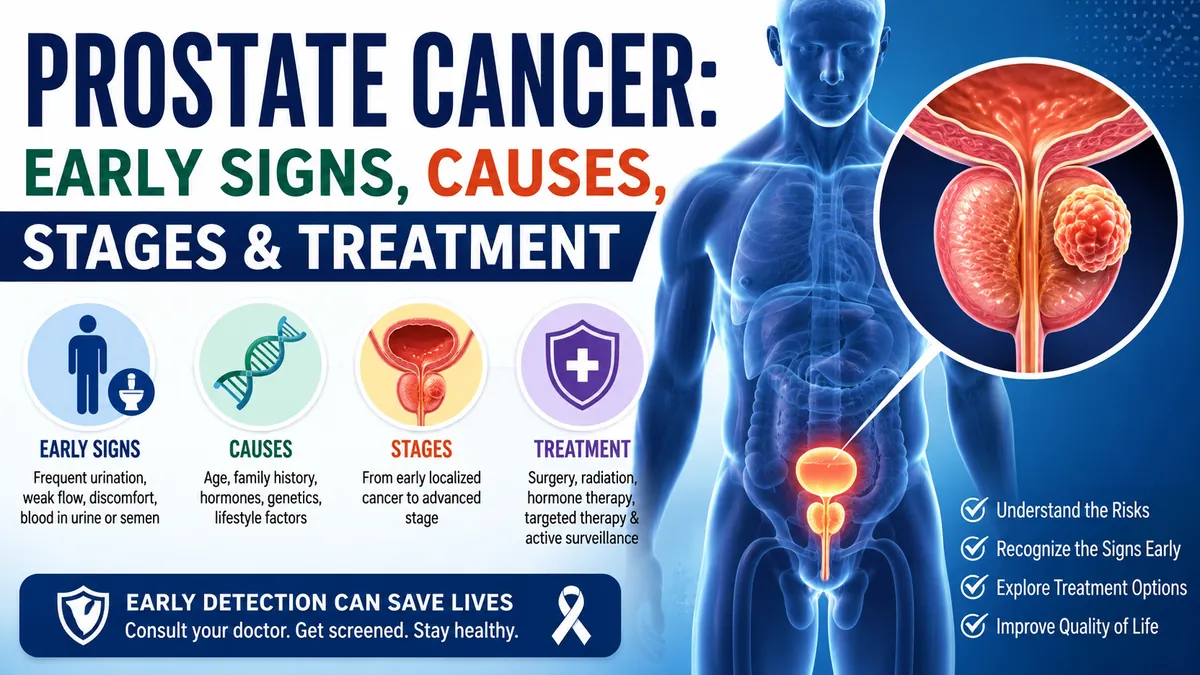
Prostate cancer is a common cancer that develops in the prostate gland, a small gland located below the bladder and in front of the rectum. The prostate surrounds part of the urethra and plays an important role in producing fluid that forms part of semen.
Many prostate cancers grow slowly and may cause no noticeable symptoms in their early stages. However, some forms can grow more quickly and spread beyond the prostate. Understanding prostate cancer symptoms, causes, risk factors, diagnosis, and treatment options can help people recognize concerning changes and seek appropriate medical advice.
What Is Prostate Cancer?
Prostate cancer occurs when abnormal cells in the prostate begin growing uncontrollably. Some tumors remain confined to the prostate and grow slowly, while others can invade nearby tissues or spread to lymph nodes, bones, or other organs.
The outlook depends on factors such as the cancer’s stage, grade, PSA level, overall health, and how quickly the tumor is growing. Localized prostate cancer can often be treated successfully, while advanced disease may require long-term treatment to control its growth.
Prostate Cancer Symptoms
One of the most important things to know about prostate cancer is that early prostate cancer often causes no symptoms. Many cases are discovered through screening or evaluation before symptoms develop.
When symptoms do occur, they may include:
- Difficulty starting urination
- Weak or slow urine flow
- Interrupted urine flow
- Frequent urination, particularly at night
- Difficulty completely emptying the bladder
- Blood in the urine
- Blood in the semen
- Pain or burning during urination in some cases
- Problems with sexual function
These symptoms do not necessarily mean prostate cancer. Benign prostatic hyperplasia (BPH), urinary infections, prostatitis, and other prostate or urinary conditions can cause similar symptoms.
Symptoms of Advanced Prostate Cancer
If prostate cancer spreads outside the prostate, symptoms may depend on where it has spread. Possible signs include:
- Persistent pain in the back, hips, or pelvis
- Unexplained tiredness
- Weakness
- Unexplained weight loss
- Loss of appetite
- Swelling in the legs in some cases
- Symptoms related to cancer spreading to the bones
Persistent or unexplained bone pain should be medically evaluated, particularly when accompanied by urinary or other prostate-related symptoms.
What Causes Prostate Cancer?
The exact cause of prostate cancer is not completely understood. Cancer develops when changes occur in the DNA of prostate cells, causing them to grow and divide abnormally.
Rather than having one specific cause, prostate cancer is associated with several risk factors. Having a risk factor does not mean that a person will definitely develop cancer, and some people develop prostate cancer without obvious risk factors.
Prostate Cancer Risk Factors
Several factors can increase the likelihood of developing prostate cancer.
1. Older Age
Age is one of the strongest risk factors. Prostate cancer becomes much more common as men get older.
2. Family History
Having a close relative, such as a father or brother, with prostate cancer can increase risk. Risk may be particularly important when several close relatives have been affected or when cancer developed at a relatively young age.
3. Inherited Gene Changes
Certain inherited genetic changes can increase prostate cancer risk. Changes involving genes such as BRCA1 and BRCA2 are among the genetic factors that may be associated with increased risk.
4. Race and Ethnicity
Prostate cancer risk varies among racial and ethnic groups. Researchers believe that a combination of genetic, environmental, healthcare-access, and other factors may contribute to these differences.
5. Lifestyle and Other Factors
Researchers continue to study factors such as body weight, physical activity, diet, and other environmental influences. Not all suspected risk factors have equally strong evidence, so lifestyle changes should be viewed as part of overall health rather than a guaranteed way to prevent prostate cancer.
How Is Prostate Cancer Diagnosed?
If symptoms or screening results raise concern, a healthcare professional may recommend several tests.
PSA Blood Test
The prostate-specific antigen (PSA) test measures PSA in the blood. An elevated PSA level can be associated with prostate cancer, but it can also occur because of noncancerous prostate enlargement, inflammation, infection, or other conditions.
Therefore, a high PSA result does not automatically mean cancer.
Digital Rectal Examination
During a digital rectal examination (DRE), a healthcare professional examines the prostate through the rectum to check for abnormalities such as unusual firmness, lumps, or changes in size.
Imaging Tests
Depending on the situation, doctors may use imaging tests such as ultrasound or magnetic resonance imaging (MRI) to examine the prostate and help determine whether an abnormal area requires further investigation.
Prostate Biopsy
A biopsy is used to confirm prostate cancer. During a biopsy, small samples of prostate tissue are collected and examined under a microscope.
Pathologists can assess the cancer’s grade, commonly reported using the Gleason grading system or Grade Group, which helps doctors understand how aggressive the cancer may be.
Prostate Cancer Stages
Doctors classify prostate cancer according to how far it has spread.
Localized Prostate Cancer
The cancer is confined to the prostate. Depending on its risk level, treatment may include active surveillance, surgery, or radiation therapy.
Locally Advanced Prostate Cancer
The cancer has grown beyond the prostate into nearby tissues or structures but has not spread to distant organs.
Metastatic Prostate Cancer
The cancer has spread to distant parts of the body. Prostate cancer commonly spreads to bones, although other organs can also be affected.
The stage, tumor grade, PSA level, imaging findings, and overall health all help determine the most appropriate treatment.
Prostate Cancer Treatment
There is no single treatment that is appropriate for every person with prostate cancer. Treatment depends on whether the cancer is low-risk, intermediate-risk, high-risk, localized, recurrent, or metastatic.
1. Active Surveillance
For some men with low-risk or slow-growing prostate cancer, immediate treatment may not be necessary.
Active surveillance involves regular monitoring through PSA testing, examinations, imaging, and sometimes repeat biopsies. Treatment can be started if there are signs that the cancer is becoming more aggressive.
This approach can help some patients avoid or delay treatment-related side effects when immediate treatment is unlikely to provide a meaningful benefit.
2. Surgery
A radical prostatectomy removes the prostate and, in some cases, nearby tissues and lymph nodes.
Surgery may be considered for certain men with localized or selected locally advanced prostate cancers.
Possible side effects include:
- Urinary leakage or incontinence
- Erectile dysfunction
- Changes in sexual function
- Other surgical complications
The likelihood and severity of side effects vary between individuals.
3. Radiation Therapy
Radiation uses high-energy radiation to destroy cancer cells.
It may be used as a primary treatment for localized prostate cancer or combined with hormone therapy for some higher-risk cancers. Radiation may also be used to relieve symptoms caused by cancer that has spread.
4. Hormone Therapy
Many prostate cancers depend on male hormones, particularly androgens, to grow.
Androgen deprivation therapy (ADT) reduces androgen activity and can slow or control prostate cancer. Hormone therapy may be used alone in some advanced cases or combined with radiation and other treatments.
Potential side effects can include hot flashes, reduced sexual desire, erectile difficulties, fatigue, changes in body composition, and bone-health concerns.
5. Chemotherapy
Chemotherapy uses medicines that destroy or slow the growth of cancer cells. It may be recommended for certain advanced or aggressive prostate cancers, often in combination with hormone-based treatment.
6. Targeted Therapy
Some prostate cancers contain specific genetic or molecular changes that can be targeted with certain medicines. For example, selected patients with particular DNA-repair gene alterations may benefit from targeted therapies.
Genetic testing may therefore be considered for some people with advanced disease or a strong family history.
7. Immunotherapy and Radiopharmaceutical Treatments
Certain advanced prostate cancers may be treated with specialized therapies that use the immune system or radioactive substances directed toward cancer cells.
These treatments are generally considered based on the cancer’s characteristics, previous treatments, overall health, and availability.
8. Clinical Trials
Clinical trials evaluate new medicines, treatment combinations, procedures, and approaches to managing prostate cancer.
For some patients, participating in a clinical trial may provide access to promising treatments that are not yet routinely available.
Can Prostate Cancer Be Prevented?
There is no guaranteed way to prevent prostate cancer. Some risk factors, including age, family history, and inherited genetic changes, cannot be changed.
Maintaining a healthy lifestyle can nevertheless support overall health. Helpful habits include:
- Eating a balanced diet
- Maintaining a healthy body weight
- Exercising regularly
- Avoiding tobacco
- Limiting excessive alcohol consumption
- Managing other chronic health conditions
- Discussing prostate cancer screening with a healthcare professional when appropriate
Lifestyle habits should complement—not replace—medical evaluation and recommended screening.
Prostate Cancer Screening
Because early prostate cancer often produces no symptoms, screening discussions can be important for people at increased risk.
Screening commonly involves consideration of a PSA blood test, sometimes together with a DRE and further testing when indicated. The benefits and potential harms of screening should be discussed with a healthcare professional because PSA testing can lead to false-positive results, unnecessary biopsies, overdiagnosis, and treatment of cancers that might otherwise never have caused problems.
The appropriate age and frequency for screening depend on individual risk factors and the recommendations followed by the patient’s healthcare provider.
When Should You See a Doctor?
Contact a healthcare professional if you experience persistent urinary changes such as:
- Difficulty starting urination
- A weak or interrupted urine stream
- Frequent nighttime urination
- Blood in the urine or semen
- Difficulty emptying your bladder
- Persistent pelvic, hip, or back pain
These symptoms can have many causes and do not automatically indicate cancer. However, getting them evaluated can help identify the underlying problem and ensure appropriate treatment.
Frequently Asked Questions
What are the first symptoms of prostate cancer?
Early prostate cancer often causes no symptoms. When symptoms occur, they may include difficulty urinating, weak urine flow, frequent urination—especially at night—and blood in the urine or semen.
What is the main cause of prostate cancer?
There is no single known cause. Prostate cancer develops from abnormal changes in prostate cells, while factors such as older age, family history, inherited gene changes, and certain demographic factors can increase risk.
Can prostate cancer be cured?
Some localized prostate cancers can be cured with appropriate treatment. Advanced prostate cancer may not always be curable, but modern treatments can often slow its progression, relieve symptoms, and help people live longer.
Is prostate cancer the same as an enlarged prostate?
No. Benign prostatic hyperplasia (BPH) is a noncancerous enlargement of the prostate. BPH can cause urinary symptoms that resemble prostate cancer, but it is not prostate cancer.
Does prostate cancer always cause urinary problems?
No. Many early prostate cancers cause no noticeable symptoms. Urinary symptoms may occur when a tumor affects the urinary tract, but their absence does not rule out prostate cancer.
What is the best treatment for prostate cancer?
There is no single best treatment for everyone. Active surveillance, surgery, radiation, hormone therapy, chemotherapy, targeted therapy, and other approaches may be considered depending on the cancer’s stage, grade, risk category, genetic characteristics, and the person’s overall health.
Final Takeaway
Prostate cancer can develop without obvious early symptoms, which makes awareness and appropriate medical evaluation important. Urinary changes, blood in the urine or semen, and persistent pelvic, hip, or back pain should not be ignored.
Treatment depends heavily on the cancer’s stage and aggressiveness. Options can range from active surveillance for selected slow-growing cancers to surgery, radiation, hormone therapy, chemotherapy, targeted treatments, and other therapies for more advanced disease.
If you are concerned about prostate cancer or have persistent urinary symptoms, speak with a qualified healthcare professional. Early evaluation can help determine whether further testing is needed and which treatment options, if any, are appropriate.
Disclaimer: This article is for general educational purposes only and does not replace professional medical advice, diagnosis, or treatment. If you have prostate cancer symptoms or concerns, consult a qualified healthcare professional for proper evaluation and personalized care.