
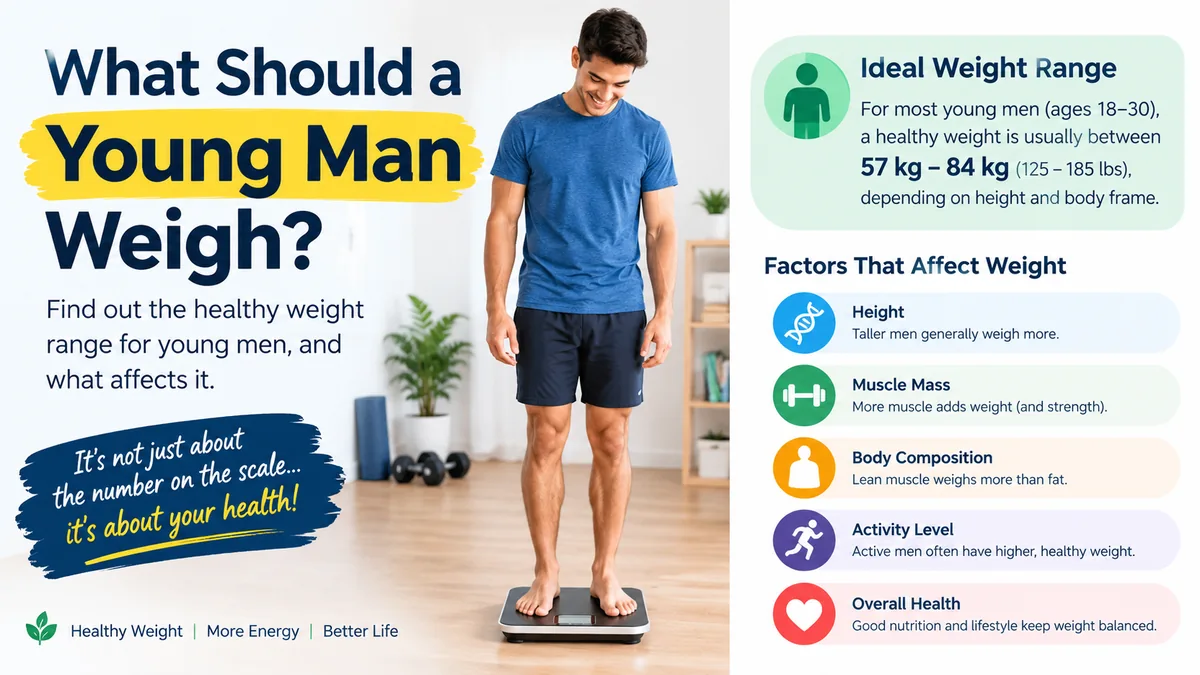
A healthy weight for a young man depends on several factors, including height, age, muscle mass, body composition, and overall health. There is no single ideal weight that applies to every man. Two men of the same height can have different healthy weights because one may have more muscle and less body fat.
For most adults, Body Mass Index (BMI) is a useful starting point for estimating whether body weight falls within a healthy range. However, BMI does not distinguish between muscle and fat, so it should be considered alongside waist circumference, lifestyle, and other health indicators.
What Is Considered a Healthy Weight?
For adults, a BMI between 18.5 and 24.9 is generally classified as the healthy-weight range. BMI is calculated using your weight and height.
BMI formula:
BMI = weight in kilograms ÷ height in meters²
For example, a young man who is 175 cm tall would generally fall within the healthy BMI range at approximately 57–76 kg.
However, this is only a general estimate. A muscular man may weigh more than this range while still having a healthy body-fat level.
Healthy Weight by Height for Young Men
The following table provides approximate weight ranges based on a BMI of 18.5–24.9:
| Height | Approximate Healthy Weight |
|---|---|
| 5’2″ (157 cm) | 46–61 kg |
| 5’4″ (163 cm) | 49–66 kg |
| 5’6″ (168 cm) | 52–70 kg |
| 5’8″ (173 cm) | 55–75 kg |
| 5’10” (178 cm) | 59–79 kg |
| 6’0″ (183 cm) | 62–83 kg |
| 6’2″ (188 cm) | 65–88 kg |
| 6’4″ (193 cm) | 69–93 kg |
These numbers are general adult estimates, not medical targets. A healthy weight can vary considerably depending on body composition and individual circumstances.
Does Age Matter?
Yes. The meaning of a “healthy weight” depends partly on whether someone has reached adulthood.
For children and teenagers, adult BMI categories should not be used. Doctors generally assess weight using BMI-for-age percentiles, which take age and sex into account.
For young men who are already adults, BMI categories are generally interpreted using adult ranges. However, health professionals may consider additional factors such as muscle mass, waist circumference, medical history, and physical activity.
Why Height Alone Does Not Determine Healthy Weight
Height is an important factor, but it isn’t the only one.
Consider two men who are both 5’10”:
- One may weigh 68 kg with relatively little muscle.
- Another may weigh 80 kg because he has substantially more muscle from strength training.
Their weights are different, but that does not automatically mean the heavier man is unhealthy.
This is one reason BMI should not be used as the only measure of health, particularly for athletes and people with significant muscle mass.
What Is a Healthy Body Fat Percentage?
Body-fat percentage can provide additional information about body composition, but there isn’t one universally accepted “perfect” percentage for every young man.
Men generally need some body fat for normal hormonal function, energy storage, and other physiological processes. Extremely low body fat isn’t necessarily healthier and can become problematic when achieved through excessive dieting or exercise.
If you’re trying to determine whether you should lose or gain weight, measuring body composition with a qualified professional can sometimes provide more useful information than body weight alone.
Waist Size Can Also Matter
Where the body stores fat is important. Abdominal fat, particularly visceral fat around internal organs, is associated with a higher risk of metabolic and cardiovascular problems.
Measuring waist circumference can therefore complement BMI.
A larger waist may indicate increased health risk even when BMI appears normal. Conversely, a muscular person may have a higher BMI without having excessive body fat.
Signs That Your Weight May Be Healthy
Weight is only one part of overall health. Other positive indicators can include:
- Having good energy levels
- Eating a varied, nutritious diet
- Getting regular physical activity
- Maintaining good cardiovascular fitness
- Having adequate sleep
- Maintaining healthy blood pressure and blood glucose
- Having a waist circumference appropriate for your body
- Being able to perform normal daily activities comfortably
A healthy weight should support your overall health rather than becoming an isolated number to achieve.
When Should a Young Man Gain Weight?
Gaining weight may be appropriate if you are significantly underweight or have unintentionally lost weight.
Healthy weight gain usually involves gradually increasing calorie intake while emphasizing nutritious foods such as:
- Eggs and dairy products
- Beans and lentils
- Nuts and seeds
- Whole grains
- Fruits and vegetables
- Lean meat, poultry, or fish
- Healthy oils and other sources of unsaturated fats
Strength training can also help increase muscle mass when combined with adequate nutrition and recovery.
If you’ve experienced unexplained or rapid weight loss, it’s important to speak with a healthcare professional because it can sometimes be associated with an underlying medical condition.
When Should a Young Man Lose Weight?
Weight loss may provide health benefits for someone carrying excess body fat, particularly when obesity or abdominal fat is affecting health.
However, extreme dieting isn’t necessary. A sustainable approach generally focuses on:
- Eating mostly nutrient-dense foods.
- Controlling portions without eliminating entire food groups unnecessarily.
- Getting regular aerobic and resistance exercise.
- Sleeping adequately.
- Managing stress.
- Losing weight gradually rather than pursuing rapid weight loss.
Even modest weight loss can improve some health markers in people who are overweight or obese.
How Much Should a Young Man Weigh to Build Muscle?
There is no specific weight that guarantees a muscular or athletic physique.
If your goal is muscle gain, focus less on reaching a particular number on the scale and more on progressive resistance training, adequate protein, sufficient calories, sleep, and recovery.
Muscle gain happens gradually. Rapidly increasing body weight can result in gaining more body fat than muscle.
Is Being Skinny Always Healthy?
No. A person can have a low body weight but still have nutritional deficiencies, inadequate muscle mass, or other health problems.
Likewise, someone with a normal BMI can have relatively high body fat and low muscle mass.
This is sometimes referred to as normal-weight obesity or metabolically unhealthy body composition. It demonstrates why weight alone doesn’t provide a complete picture of health.
Is Being Overweight Always Unhealthy?
Not necessarily.
BMI is a screening measure rather than a diagnosis. It doesn’t directly measure body fat, muscle mass, or fat distribution.
For example, a young man who regularly lifts weights may have a higher BMI because of increased muscle mass. A healthcare professional can consider his body composition and other health measurements before determining whether his weight is actually a concern.
Healthy Weight for a 20-Year-Old Man
A healthy weight for a 20-year-old man depends primarily on his height and body composition, rather than the age of 20 itself.
For example, a 20-year-old man who is 5’8″ may have a healthy weight that differs significantly from a 20-year-old man who is 6’2″.
Instead of asking, “What should a 20-year-old man weigh?” it’s more useful to ask:
“What is a healthy weight range for my height and body composition?”
Healthy Weight for a 25-Year-Old Man
The same principle applies at age 25. There is no universal ideal weight for all 25-year-old men.
Adult BMI categories can provide a starting point, but your muscle mass, waist circumference, physical activity, diet, and overall health should also be considered.
How to Find Your Healthy Weight
A practical approach is to use several measurements rather than relying on the scale alone.
Step 1: Calculate Your BMI
Use your height and weight to calculate BMI.
Step 2: Consider Your Waist Circumference
A larger waist can indicate excess abdominal fat and increased metabolic risk.
Step 3: Think About Body Composition
If you exercise regularly or have substantial muscle mass, BMI may overestimate your body-fat level.
Step 4: Look at Your Overall Health
Blood pressure, blood glucose, cholesterol, fitness, nutrition, sleep, and lifestyle all provide additional information.
Step 5: Talk to a Healthcare Professional When Needed
If you’re unsure whether you should lose, gain, or maintain weight, a doctor or registered dietitian can assess your individual situation.
Frequently Asked Questions
What is the ideal weight for a young man?
There is no single ideal weight for every young man. A healthy weight depends mainly on height, body composition, muscle mass, and overall health. BMI can provide a general starting point for adults.
What is a healthy weight for a 5’10” man?
Using the adult BMI range of 18.5–24.9, a 5’10” (178 cm) man has an approximate healthy weight range of 59–79 kg. Individual needs can vary, especially for muscular men.
What is a healthy weight for a 6-foot man?
For a 6-foot (183 cm) adult man, a BMI-based healthy weight range is approximately 62–83 kg. This is an estimate rather than a specific target.
Can a muscular man have a high BMI?
Yes. BMI cannot distinguish muscle from body fat. A muscular young man may have a BMI in the overweight range despite having relatively low body fat.
Should young men focus on BMI or body fat?
BMI is useful as a screening tool, but body composition, waist circumference, lifestyle, and overall health can provide additional information. Using several measures gives a more complete picture.
Final Thoughts
So, what is a healthy weight for a young man? There isn’t one number that works for everyone. Height-based BMI ranges can provide a useful starting point, but muscle mass, body-fat distribution, lifestyle, and overall health also matter.
Rather than chasing a specific number on the scale, focus on maintaining a healthy body composition, nutritious diet, regular physical activity, adequate sleep, and sustainable habits.
If your weight changes unexpectedly, you are significantly underweight or overweight, or you’re considering major changes to your diet or exercise routine, speak with a qualified healthcare professional for personalized advice.