
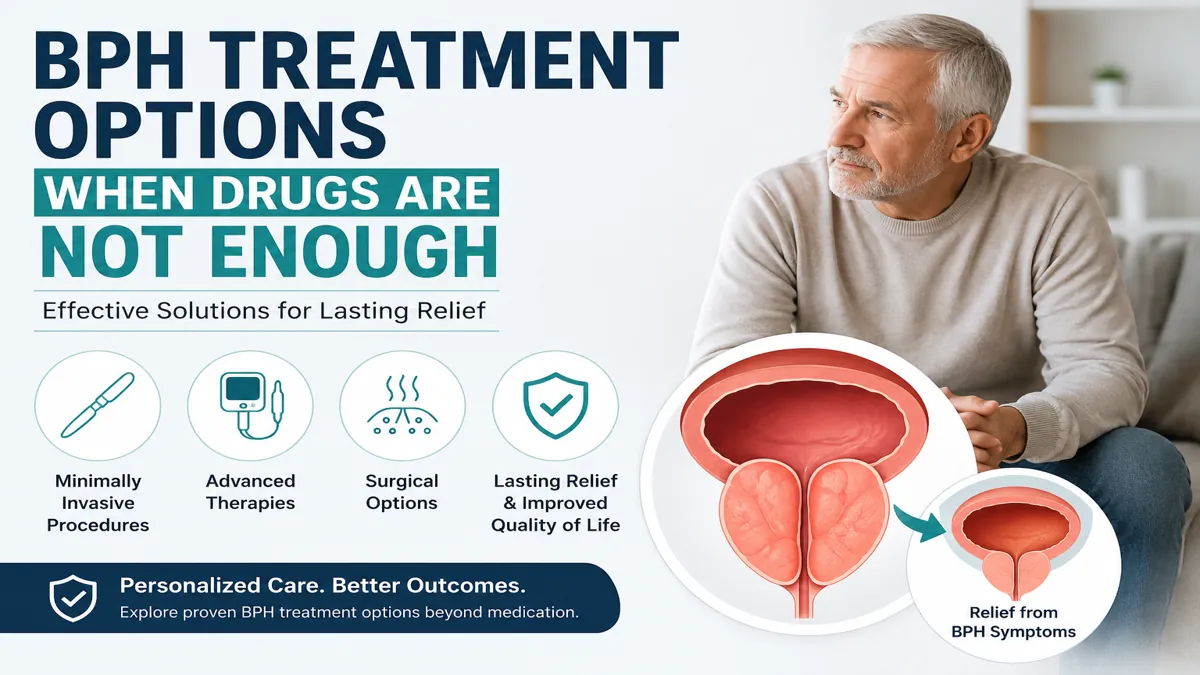
Benign Prostatic Hyperplasia (BPH), also known as an enlarged prostate, is a common condition affecting millions of men as they age. While medications are often the first line of treatment, they do not work for everyone. Some men continue to experience bothersome urinary symptoms despite taking prescription drugs, while others develop side effects that make long-term medication difficult.
Fortunately, there are several effective BPH treatment options when drugs are not enough. Advances in minimally invasive procedures and surgical techniques now offer long-lasting symptom relief with shorter recovery times than traditional surgery.
This guide explains when it’s time to consider additional treatment, the available procedures, and how doctors determine the best option for each patient.
What Is Benign Prostatic Hyperplasia (BPH)?
Benign Prostatic Hyperplasia is a non-cancerous enlargement of the prostate gland. As the prostate grows, it can press against the urethra, making it difficult for urine to flow freely.
Common symptoms include:
- Frequent urination
- Urgent need to urinate
- Weak urine stream
- Difficulty starting urination
- Interrupted urine flow
- Feeling that the bladder doesn’t empty completely
- Waking up multiple times during the night to urinate (nocturia)
Although BPH is not prostate cancer, untreated severe symptoms can reduce quality of life and sometimes lead to complications.
When Are Medications No Longer Enough?
Doctors usually prescribe medications such as alpha-blockers or 5-alpha reductase inhibitors to relieve symptoms.
However, treatment may need to change if:
- Symptoms remain severe after several months
- Urinary retention develops
- Recurrent urinary tract infections occur
- Bladder stones form
- Blood appears repeatedly in urine
- Kidney function becomes affected
- Medication side effects become intolerable
- The prostate continues growing despite treatment
If these issues occur, your healthcare provider may recommend procedural or surgical treatment.
Minimally Invasive BPH Treatment Options
Many modern treatments can be performed without major surgery. These procedures generally involve less pain, shorter hospital stays, and faster recovery.
1. UroLift System
The UroLift procedure uses small permanent implants to hold enlarged prostate tissue away from the urethra.
Benefits
- No tissue removal
- Usually performed as an outpatient procedure
- Rapid symptom improvement
- Short recovery time
- Lower risk of sexual side effects
Best For
- Mild to moderate prostate enlargement
- Men wishing to preserve sexual function
Possible Risks
- Temporary burning during urination
- Mild bleeding
- Frequent urination for several days
2. Rezūm Water Vapor Therapy
Rezūm uses controlled steam injections to destroy excess prostate tissue.
Over several weeks, the treated tissue shrinks naturally, improving urine flow.
Benefits
- Minimally invasive
- Preserves erectile function in most men
- Outpatient procedure
- Durable symptom relief
Recovery
Most patients resume normal activities within a few days, although improvement develops gradually over several weeks.
3. Prostatic Artery Embolization (PAE)
PAE is performed by an interventional radiologist.
Tiny particles are injected into the arteries supplying the prostate, reducing blood flow and causing the gland to shrink.
Advantages
- No surgical incision
- Local anesthesia
- Suitable for some high-risk surgical patients
Limitations
- Not appropriate for everyone
- Long-term results continue to be studied
4. Temporary Implantable Devices
Some newer devices temporarily reshape the prostate to improve urine flow.
These treatments:
- Require minimal anesthesia
- Can often be performed in the clinic
- Usually involve short recovery periods
Availability varies depending on the healthcare facility.
Surgical Treatments for Severe BPH
When the prostate is very large or symptoms are severe, surgery often provides the most effective long-term relief.
1. Transurethral Resection of the Prostate (TURP)
TURP remains one of the most common surgeries for BPH.
During the procedure, a surgeon removes excess prostate tissue through the urethra using a specialized instrument.
Benefits
- Excellent long-term symptom relief
- Improved urine flow
- Well-established procedure
Recovery
- Hospital stay of one to two days in many cases
- Temporary urinary catheter
- Recovery over several weeks
2. Laser Prostate Surgery
Laser procedures include:
- Holmium Laser Enucleation (HoLEP)
- GreenLight Laser Therapy
These surgeries use laser energy to remove or vaporize enlarged tissue.
Advantages
- Less bleeding
- Faster recovery
- Suitable for patients taking blood thinners (depending on individual circumstances)
- Effective for larger prostates
3. Aquablation Therapy
Aquablation combines robotic technology with a high-pressure water jet to remove prostate tissue.
Real-time ultrasound guidance allows precise treatment.
Benefits
- High precision
- Reduced risk of certain complications
- Effective for larger prostates
4. Simple Prostatectomy
For extremely enlarged prostates, doctors may recommend removal of the enlarged portion of the prostate through open, laparoscopic, or robotic-assisted surgery.
This option is generally reserved for very large glands.
Comparing BPH Treatment Options
| Treatment | Best For | Hospital Stay | Recovery | Sexual Function |
|---|---|---|---|---|
| UroLift | Mild to moderate BPH | Usually none | Few days | Usually preserved |
| Rezūm | Moderate BPH | Usually none | Several days | Usually preserved |
| PAE | Selected patients | None or overnight | Few days | Generally preserved |
| TURP | Moderate to severe BPH | 1–2 days | 2–6 weeks | Retrograde ejaculation is common |
| Laser Surgery | Moderate to large prostate | Overnight | 1–3 weeks | Lower bleeding risk; sexual effects vary |
| Aquablation | Moderate to large prostate | Overnight | 2–4 weeks | Often preserves ejaculation better than some surgeries |
| Simple Prostatectomy | Very large prostate | Several days | Several weeks | Higher likelihood of sexual side effects |
How Doctors Choose the Right Treatment
Several factors influence treatment recommendations, including:
- Age
- Overall health
- Prostate size
- Severity of symptoms
- Bladder function
- Previous treatments
- Desire to preserve sexual function
- Personal preferences
- Risk of complications
Your healthcare provider may perform urine tests, blood tests, ultrasound, cystoscopy, or urodynamic studies before recommending a procedure.
Recovery After BPH Procedures
Recovery depends on the treatment performed.
General recommendations include:
- Drink plenty of fluids unless advised otherwise.
- Avoid heavy lifting for several weeks after surgery.
- Limit alcohol and caffeine during recovery.
- Follow medication instructions carefully.
- Attend all follow-up appointments.
- Contact your doctor if you develop fever, heavy bleeding, or an inability to urinate.
Most men notice significant improvement in urinary symptoms within days to weeks, though some procedures provide gradual improvement over several months.
Potential Risks and Complications
All medical procedures carry some risks.
Possible complications include:
- Temporary burning during urination
- Blood in the urine
- Urinary tract infection
- Temporary urinary retention
- Urinary incontinence (uncommon with many procedures)
- Erectile dysfunction (less common with newer techniques)
- Retrograde ejaculation, particularly after TURP and some laser procedures
- Need for additional treatment if symptoms recur
Discuss the risks and benefits of each option with your healthcare provider.
Can Lifestyle Changes Still Help?
Even after a procedure, healthy habits can support urinary health.
Consider:
- Limiting fluids before bedtime
- Reducing caffeine and alcohol intake
- Maintaining a healthy weight
- Staying physically active
- Avoiding medications that may worsen urinary symptoms unless prescribed
- Practicing bladder training if recommended
These measures may help improve overall symptom control.
Frequently Asked Questions (FAQs)
Which BPH treatment works best when medication fails?
There is no single best treatment for everyone. UroLift, Rezūm, TURP, laser surgery, Aquablation, and other options each have advantages depending on prostate size, symptom severity, overall health, and personal preferences.
Is surgery always necessary?
No. Many men benefit from minimally invasive procedures that do not require traditional surgery.
Which treatment has the fastest recovery?
Procedures such as UroLift and Rezūm generally have shorter recovery times than traditional surgery, though symptom improvement may occur gradually with some treatments.
Can BPH return after treatment?
Yes. Some men may require additional treatment years later, although many procedures provide long-lasting relief.
Will treatment affect sexual function?
Many newer minimally invasive procedures are designed to reduce the risk of sexual side effects. However, some surgeries—particularly TURP—commonly cause retrograde ejaculation. Discuss potential effects with your healthcare provider before treatment.
Conclusion
When medications no longer control the symptoms of benign prostatic hyperplasia, effective alternatives are available. From minimally invasive procedures like UroLift, Rezūm, and Prostatic Artery Embolization to established surgical options such as TURP, laser prostate surgery, Aquablation, and simple prostatectomy, modern BPH care offers a range of solutions tailored to different needs.
The best treatment depends on your prostate size, symptom severity, overall health, and treatment goals. Consulting a qualified urologist can help you choose the option that provides the greatest benefit while minimizing risks. Early evaluation and timely treatment can improve urinary function, protect bladder and kidney health, and enhance your overall quality of life.